


Social Media Policy for Employees: California 2026 Guide

A social media policy for employees is a formal set of guidelines California employers use to manage lawful employee social media conduct while protecting company interests and respecting employee rights under state law. Getting this right matters more than ever in 2026, because California has some of the strongest employee protections in the country, and a poorly drafted policy can expose your business to legal liability just as fast as having no policy at all.
Here is what every California employer needs to know upfront:
Au 17 juillet 2026, la loi du Code du travail de Californie § 980 interdit aux employeurs d’exiger des employés qu’ils divulguent les mots de passe de leurs réseaux sociaux ou donnent accès à leurs comptes personnels, sauf exception liée à des enquêtes sur des comportements répréhensibles.
Labor Code § 96(k) protects employees from adverse actions for lawful off-duty conduct, including personal social media posts.
Employers can regulate social media use during work hours, on company devices, and when it involves confidentiality breaches or harassment.
Overly broad bans on personal social media use are often unenforceable and damage morale.
Every policy needs a clear scope, defined prohibited conduct, a disciplinary process, and an employee acknowledgment section.
What are the key legal rights and employer limits for employee social media in California?
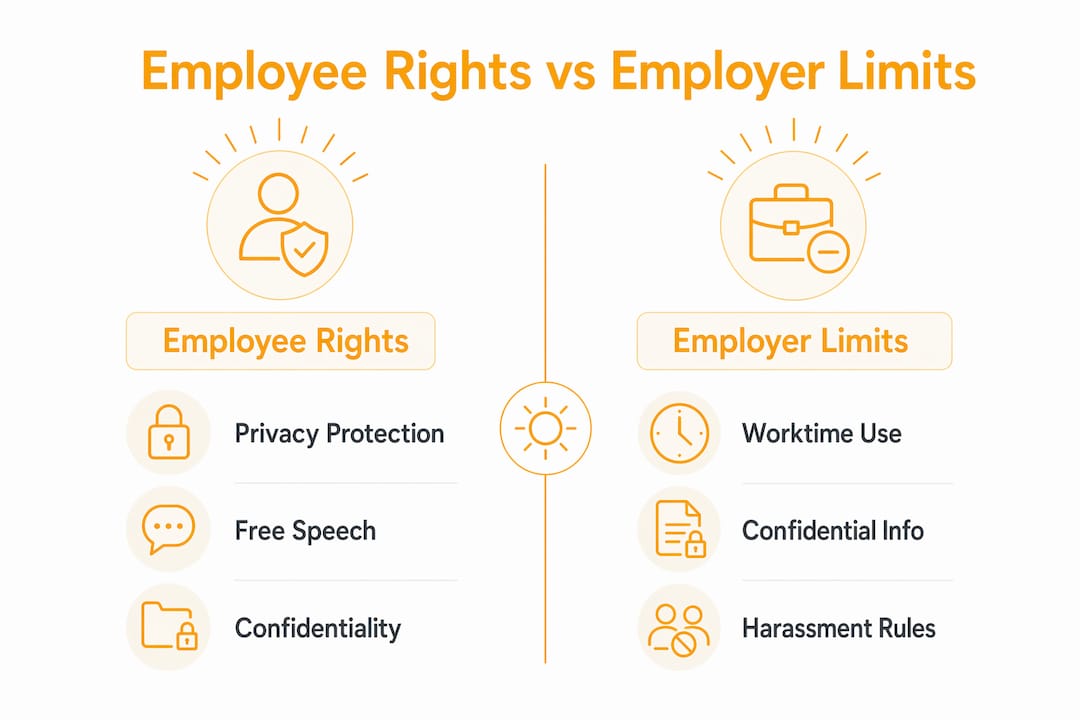
California law draws a clear line between what employers can and cannot do. Cross it, and you face retaliation claims, privacy lawsuits, or NLRA violations.
What employers can regulate:
Personal social media use during work hours or on company-owned devices
Posts that disclose confidential business information, client lists, or trade secrets
Content that harasses coworkers based on protected characteristics such as race, religion, or national origin
Posts where an employee appears to speak on behalf of the company without authorization
Unlawful conduct, even when it happens off-duty
What employers cannot regulate:
Employees discussing wages, hours, benefits, or working conditions (protected under the National Labor Relations Act, even in nonunion workplaces)
Political beliefs, affiliations, or participation in political activity
Disclosure of facts related to workplace sexual harassment, depending on circumstances
La loi du Code du travail de Californie § 980 est claire : au 17 juillet 2026, les employeurs ne peuvent pas demander aux employés de communiquer leurs identifiants ou mots de passe, d’accéder à leurs comptes personnels en présence de l’employeur, ni de remettre des contenus privés de réseaux sociaux, sauf exception justifiée par une enquête sur une faute présumée et dans ce cas, les informations ne doivent servir qu’à cette enquête.
Retaliation is also prohibited. If an employee refuses an improper request for account access, firing or disciplining them for that refusal violates the statute directly.
Key legal boundary: Public posts carry lower privacy expectations. Once an employee publishes content publicly, California courts have held that the right to privacy may be considered waived for that content. Private accounts, direct messages, and password-protected content are a different matter entirely.
California employers monitoring social media also face CCPA and CPRA obligations, including providing privacy notices and maintaining proper data retention practices. If you use an AI-based monitoring tool, the legal exposure multiplies: discrimination, disability, and data-security questions all come into play.
What should every California employee social media policy include?
A well-built policy protects the business without overreaching into employees’ personal lives. These are the elements that belong in every compliant California policy:
Scope and applicability: Specify whether the policy covers work hours only, company devices, or both. State clearly that it applies to all employees, contractors, and temporary staff.
Definition of social media: Use the statutory definition from Labor Code § 980, which covers videos, photographs, blogs, podcasts, text messages, email, and online profiles.
Prohibited conduct: Name specific behaviors, including disclosing confidential information, impersonating the company, posting harassing content targeting protected classes, and making false statements about the company or its competitors.
Employee rights notice: Inform employees of their rights under § 96(k) and § 980, and confirm the company will not request passwords or personal account access.
Monitoring disclosure: Explain what the company does and does not monitor. California employers must be specific here, not vague.
Disciplinary process: Outline the investigation steps, who conducts them, and what range of discipline applies, from a written warning to termination.
Protected activity carveout: Explicitly state that the policy does not prohibit discussion of wages, hours, or working conditions.
Employee acknowledgment: Require a signed acknowledgment confirming the employee received and read the policy.
Pro Tip: Focus your policy on professionalism, confidentiality, accuracy, and brand representation rather than attempting a blanket ban on personal social media use. Broad bans are difficult to enforce and often create more legal risk than they prevent.
How do California social media management agencies compare?

California employers who need outside help with social media policy consultation, training, or ongoing content management have several specialized agencies to consider. Each serves a distinct market.
Agency | Services Offered | Specializations | Certifications and Recognition | Best For | Rating |
Viral video content, paid ads, websites and landing pages | Local contractors, remodelers, HVAC, roofing, home services | — | Contractors and home service businesses targeting local California markets | 5★ (57 reviews) | |
Personal branding, social media strategy and management, visual content creation, consulting and audits | Personal brands, coaches, entrepreneurs | Award-winning content strategist | Coaches and entrepreneurs building intentional personal brands | 5★ (36 reviews) | |
Digital brand strategy, high-impact campaigns, influencer and brand ambassador, media buying, public relations | Millennial, Gen Z, and Hispanic audiences; international multilingual campaigns | Designrush Accredited Agency, UpCity Best of Creative Design, UpCity Best of Marketing and Advertising, Clutch Los Angeles Top Advertising and Marketing Agencies, Hispanic Star | Businesses running multilingual or international campaigns | 5★ (25 reviews) | |
— | — | — | — | — |
Social Era Media focuses on local market domination for contractors and home service professionals, making it a practical fit for California construction and trades businesses that need both marketing execution and a clear online presence strategy. Content Social Media Queen takes a boutique approach, working closely with coaches and entrepreneurs who want a highly personalized content strategy rather than a volume-driven campaign. Social Media Relations stands out for its depth of industry recognition and its ability to run multilingual campaigns targeting diverse California demographics, including Hispanic audiences and Gen Z consumers. Social Media Colleague has no publicly listed service details at this time.
How do you build and implement a compliant social media policy in California?
Follow these steps to move from a blank document to a policy your team actually understands and follows.
Assess your business risks. Identify what your company is most vulnerable to: confidentiality leaks, reputational harm, harassment claims, or all three. Your policy should address your actual risks, not a generic checklist.
Draft policy language aligned with California law. Reference Labor Code §§ 96(k) and 980 directly. Include the protected activity carveout and the monitoring disclosure. Have employment counsel review the draft before distribution.
Define prohibited conduct with specifics. Vague language like “inappropriate posts” invites disputes. Name the behaviors: disclosing client data, impersonating the company, posting harassing content targeting protected classes.
Train employees before enforcement. A policy no one understands is a policy that will not hold up in a dispute. Run a short training session, cover the key rules, and answer questions in writing.
Collect signed acknowledgments. Keep a copy in each employee’s file. This is your evidence that the employee received the policy.
Establish an investigation procedure. When a potential violation surfaces, document who reported it, what was reviewed, and what decision was made. Never pressure an employee to hand over personal account credentials during an investigation without legal counsel involved.
Review and update annually. California law changes. Schedule a policy review each year, or sooner if a major legal development occurs.
Expert insights from SOL Social Media on managing California employee social media policies
At SOL Social Media, we work with small businesses across California that are building their online presence while managing the real-world complexity of employee conduct online. The pattern we see most often: employers either say nothing about social media until something goes wrong, or they write a policy so restrictive it creates resentment before anyone even posts anything.
Transparency is the foundation of any policy that actually works. Employees who understand why the rules exist, and what the company will and will not monitor, are far more likely to follow the guidelines than those who feel surveilled without explanation.
The most effective employee social media guidelines we have seen share three qualities. They focus on professionalism and confidentiality rather than personal conduct bans. They include a clear, written explanation of what the company does not monitor. And they pair the written policy with a short training session so employees hear the reasoning directly.
Pro Tip: When managing your brand’s online reputation, treat employee social media as part of your brand ecosystem, not a separate problem. Employees who understand your brand voice are your best advocates, not your biggest risk.
A few additional practices worth building into your approach:
Avoid monitoring tools that score or flag employees automatically without human review.
Never use a coworker as an informal backdoor into another employee’s private account.
Keep disciplinary decisions consistent. Selective enforcement is one of the fastest ways to turn a policy dispute into a lawsuit.
Document every step of an investigation, including what you reviewed, how you obtained it, and what conclusion you reached.
SOL Social Media offers a different path for small businesses
If the agencies compared above feel like a larger investment than your small business needs right now, SOL Social Media offers a practical alternative focused on building your social media presence from the ground up, with real human copywriting and a strategy built around your specific goals.
SOL Social Media works with small businesses across California, from retail to healthcare, that want consistent, authentic content without the overhead of a large agency retainer. The focus is on genuine community engagement and brand voice, not templated campaigns. Whether you need a social media strategy built around your business goals or ongoing content management that reflects who you actually are, SOL Social Media builds it around your audience, not a generic playbook. Reach out to see how a personalized approach fits your budget and your team.
Key Takeaways
A compliant California social media policy protects your business by combining clear legal boundaries, specific prohibited conduct, and transparent monitoring disclosures that employees actually understand.
Point | Details |
Code du travail californien § 980 (au 17 juillet 2026) | Les employeurs ne peuvent pas demander les mots de passe des réseaux sociaux ni forcer l’accès aux comptes personnels des employés, sauf exceptions très limitées liées à une enquête sur un comportement répréhensible. |
Labor Code § 96(k) protection | Employees are protected from adverse actions for lawful off-duty social media activity that does not harm legitimate business interests. |
Policy must-haves | Include scope, definitions, prohibited conduct, a protected activity carveout, monitoring disclosure, and a signed acknowledgment. |
Enforcement limits | Broad bans on personal social media use are often unenforceable and damage morale; focus on professionalism and confidentiality instead. |
SOL Social Media | Offers small California businesses personalized social media strategy and content management as an alternative to large agency contracts. |
FAQ
Can my employer tell me what I can and can’t post on social media?
Yes, within limits. California employers can regulate social media use on company time and devices, and prohibit posts that disclose confidential information or harass coworkers, but they cannot restrict employees from discussing wages, hours, or working conditions, which are protected under the National Labor Relations Act.
What is an example of a social media policy for employees?
A compliant California policy states that employees may not disclose confidential company information, impersonate the company, or post harassing content targeting protected classes, while also confirming that the company will not request social media passwords and that employees retain the right to discuss working conditions online.
Can an employer terminate an employee for social media posts?
Yes, in some cases. Public posts that harm legitimate business interests, violate confidentiality, or constitute harassment can justify termination, but employers cannot fire an employee for lawful off-duty conduct protected under Labor Code § 96(k) or for refusing to hand over personal account credentials.
Quelle est la nouvelle loi en Californie concernant les réseaux sociaux ?
Au 17 juillet 2026, la loi du Code du travail de Californie § 980 interdit toujours aux employeurs de demander les mots de passe ou d’exiger l’accès aux comptes personnels des employés, sauf s’il s’agit d’une enquête sur un comportement répréhensible et que les informations sont utilisées uniquement dans ce contexte.
Recommended
Comments