


Why Your Instagram Engagement Is Low (and How to Fix It)

Low Instagram engagement is rarely about one bad post. It reflects a deeper misalignment between your content, your audience, and Instagram’s evolving algorithm. The platform evaluates every piece of content through a lens of relevance and interaction quality, and when those signals weaken, your reach contracts fast.
Here is what typically drives engagement down:
Content drift: Your account has shifted topics, and your original followers no longer connect with what you post.
Ghost followers: Inactive accounts drag down your early engagement velocity, signaling to Instagram that your content is not worth distributing.
Algorithm penalties: Reposting watermarked videos or using flagged hashtags can quietly suppress your reach.
Format fatigue: Posting only one content type trains your audience to stop engaging.
Low follower quality: Followers gained through giveaways or non-organic tactics often never interact, pulling your engagement-per-reach ratio down.
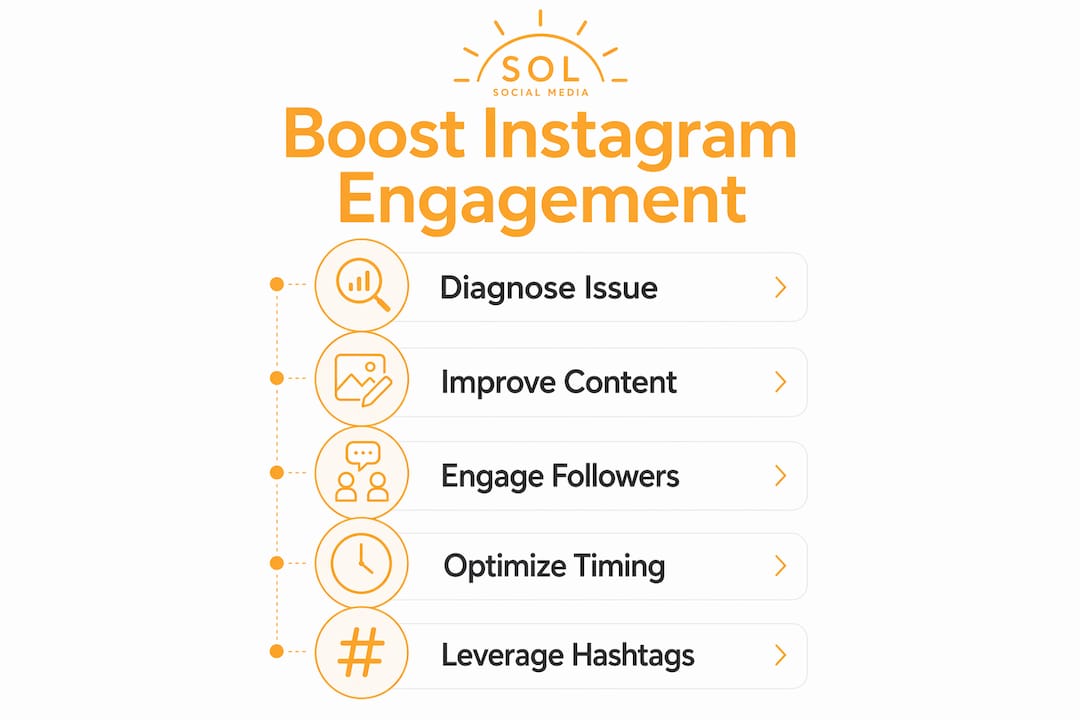
The good news is that most of these causes are diagnosable and correctable. The 5-3-2 content rule and the 5-3-1 engagement rule give you a practical framework to rebalance your strategy. Follower quality audits, posting time optimization, and interactive Stories features all move the needle. The key is approaching this like a diagnostic, not a panic.
What causes low Instagram engagement?
Engagement drops rarely happen for one reason. They tend to stack, and understanding each cause separately makes it easier to fix the right thing.
Content drift is one of the most common culprits. When an account gradually shifts away from its original niche, followers disengage and the algorithm reduces distribution because the content no longer matches the audience’s established interests.
Format fatigue happens when you rely too heavily on one content type. An account that posts only static images, for example, misses the reach advantage that Reels and carousels provide.
Audience decay occurs when followers become inactive over time, especially if they were gained through giveaways or viral moments unrelated to your core content. These followers rarely interact, which suppresses your engagement rate even as your follower count stays flat.
Repetitive or flagged hashtags can trigger algorithmic penalties. Using the same set of hashtags on every post, or including tags associated with spam, signals low-quality behavior to the platform.
Posting cadence issues cut both ways. Posting too frequently without maintaining quality leads to content burnout, while posting too infrequently causes the algorithm to deprioritize your account.
Shadowban-like suppression is often blamed on mysterious algorithm changes, but it is more frequently the result of content drift or restricted hashtag use. The account is not banned; it has simply drifted out of relevance for its own audience.
Identifying which of these applies to your account is the first step. Check your Instagram Insights for a sudden drop in reach versus a gradual one. A sudden drop usually points to a mechanical cause. A gradual decline usually signals content or audience drift.
The 5-3-2 and 5-3-1 rules can rebalance your content strategy

Two frameworks stand out for creators and small businesses trying to build consistent, authentic engagement: the 5-3-2 content rule and the 5-3-1 engagement rule. Neither requires a large budget or a full content team. Both require intention.
The 5-3-2 rule structures your content mix across every 10 posts:
5 curated posts: Share content from other sources that is relevant and valuable to your audience. This positions you as a trusted resource, not just a self-promoter.
3 original posts: Publish content you have created that speaks directly to your audience’s interests or problems. This is where your expertise shows.
2 personal posts: Show the human side of your brand. Behind-the-scenes moments, team highlights, or candid opinions build the kind of relatability that keeps followers coming back.
This content mix prevents the hard-sell fatigue that drives unfollows and builds the trust that turns casual followers into active community members. You can explore more content mixing ideas in this guide to what to post on social media.
The 5-3-1 engagement rule shifts focus from what you post to how you interact:
For every 1 promotional post you publish, engage with 5 relevant posts from others in your niche.
Share or support 3 other creators through reposts, story mentions, or genuine comments.
This rule builds reciprocal engagement and signals to the algorithm that your account is an active participant in the community, not just a broadcaster. Applied consistently, both rules help counteract content drift and rebuild the engagement velocity that Instagram uses to decide how widely to distribute your posts.
How follower quality affects your engagement rate
Your follower count is a vanity metric if the people behind it are not actually watching, saving, or sharing your content. Instagram does not measure success by how many followers you have. It measures how many of them engage with what you post.
Ghost followers, meaning accounts that are inactive or were never genuinely interested in your content, suppress your reach by reducing the early engagement signal Instagram uses to decide distribution. When a post goes live and only a fraction of your audience interacts in the first 30–60 minutes, the algorithm interprets that as low relevance and limits how many non-followers see it.
Followers gained through giveaways, follow-for-follow tactics, or purchased engagement are the most common source of this problem. They inflate your count while dragging your engagement-per-reach ratio down. You can audit your follower quality using an Instagram follower ratio calculator to identify accounts that are pulling your metrics in the wrong direction.
The fix is not to obsess over removing every inactive follower. It is to stop adding low-quality followers and start attracting people who genuinely care about your content. Niche-specific hashtags, collaborations with aligned creators, and consistent posting within a defined content pillar all draw the right audience over time. For a deeper look at audience targeting by platform, SOL Social Media’s guide to social media demographics breaks down who is actually on each platform and how to reach them.
Expert strategies to increase Instagram engagement in 2026
Recovering from an engagement drop requires both a short-term triage and a longer-term content reset. Here is what actually works.
Prioritize original content with a strong hook. Instagram’s algorithm in 2026 penalizes recycled videos and watermarked TikTok reposts. Every Reel you publish should be native to Instagram, with a hook in the first 1–3 seconds that stops the scroll.
Focus on high-value engagement signals. Comments, saves, and shares carry significantly more weight than likes. Write captions that invite a specific response, ask a direct question, or prompt saves with a “bookmark this” call to action.
Post when your audience is active. Engagement velocity in the first 30–60 minutes after posting is a primary distribution signal. Posting at the wrong time wastes that window.
Use interactive Stories features. Polls, question stickers, and quizzes in Stories generate direct interaction that feeds the algorithm’s engagement signals without requiring a full production effort.
Run a 7–14 day corrective protocol if you suspect a mechanical drop. Archive any flagged Reels, pause hashtag-heavy posting, and focus on high-quality original content. Sudden reach declines from community guideline flags or originality penalties are typically reversible within this window when addressed directly.
Reply to comments quickly. Responding within the first hour of posting extends the engagement window and signals to the algorithm that your post is generating active conversation.
Avoid panic posting. Flooding your feed with low-effort content to compensate for a drop makes the problem worse. Quality and consistency beat volume every time.
Pro Tip: Sustained engagement comes from community, not content volume. Spend 15 minutes each day genuinely engaging with accounts in your niche before you post. That activity warms up the algorithm and builds the reciprocal relationships that drive organic reach. SOL Social Media’s community involvement approach is built on exactly this principle.
When is the best time to post on Instagram?
There is no universal “best time” that works for every account, but there are patterns worth knowing. For most U.S.-based accounts, mid-morning posts on Tuesday, Wednesday, and Thursday tend to perform well, with Tuesday between 9 AM and 11 AM consistently showing strong engagement across multiple studies. For California-based creators, that aligns with Pacific Time morning hours when your West Coast audience is starting their day and East Coast followers are already active at midday.
The most reliable approach is to check your own Instagram Insights under the “Audience” tab, which shows when your specific followers are most active by day and hour. Post within that window and then engage actively in the comments for the first 30–60 minutes. That combination of timing and early interaction is what maximizes your distribution in the algorithm’s first evaluation cycle.
How Instagram’s algorithm actually affects your engagement
Instagram’s algorithm does not rank posts chronologically. It ranks them by predicted relevance to each individual user, based on signals like watch time, saves, shares, comments, and profile visits after viewing. Likes rank as a moderate signal at best.
Comments and shares carry the most weight because they indicate active intent. A user who shares your Reel is telling the algorithm that your content is worth spreading. A user who saves your carousel is signaling that your content has lasting value. Both behaviors push your content to more non-followers through the Explore page and Reels feed.
The algorithm also evaluates your account’s overall originality. Accounts that consistently publish native, original content receive preferential distribution. Accounts that recycle content or use restricted hashtags get throttled, sometimes without any visible notification.
How to read Instagram Insights to find engagement patterns
Instagram Insights gives you the data to stop guessing. Pull it weekly and look for these specific patterns.
Navigate to your professional dashboard and review each post’s reach, impressions, and engagement breakdown. Compare reach to follower count: if reach is consistently below 10% of your followers, you likely have an audience quality or algorithm penalty issue. Look at which content formats drive the most saves and shares, not just likes, since those are the signals that actually expand your reach.
Check your audience retention on Reels. A completion rate significantly above average on Reels under 30 seconds is a strong signal that your content is holding attention. Below that threshold, your hook or pacing needs work. Track these numbers over a 30-day rolling window to identify trends rather than reacting to individual post performance.
How to use hashtags without hurting your reach
Hashtag strategy has shifted considerably. Instagram itself has stated that using three to five highly relevant hashtags outperforms stuffing 20–30 generic ones. The platform’s algorithm now reads hashtags as content classification signals, not discovery amplifiers, so relevance matters far more than volume.
Rotate your hashtag sets across posts rather than using the same group every time. Repeating identical hashtags signals repetitive, low-effort behavior and can trigger distribution limits. Mix niche-specific tags (under 500K posts) with mid-size tags (500K–2M posts) and avoid any hashtag that has been flagged or restricted. You can check a hashtag’s status by searching it directly in the app; if the top posts look spammy or the tag shows a “posts hidden” notice, drop it from your rotation entirely.
For a practical look at engagement tactics that go beyond hashtags, SOL Social Media’s resource library covers proven methods for building genuine interaction across platforms.
Key Takeaways
Low Instagram engagement is fixable when you address the right causes: audience quality, content relevance, and algorithm alignment all need attention simultaneously.
Point | Details |
Content drift kills reach | Shifting away from your niche alienates followers and reduces algorithmic distribution. |
Follower quality over count | Ghost followers suppress early engagement velocity, limiting how widely Instagram distributes your posts. |
Apply the 5-3-2 rule | Balance every 10 posts as 5 curated, 3 original, and 2 personal to build trust and reduce promotional fatigue. |
Prioritize saves and shares | Comments, saves, and shares carry more algorithmic weight than likes in 2026. |
Timing and early engagement matter | Posting when your audience is active and engaging in the first 30–60 minutes maximizes distribution. |
FAQ
Why is my Instagram engagement suddenly so low?
Sudden drops are usually mechanical: a community guideline flag, an originality penalty from recycled content, or a restricted hashtag. Gradual declines more often reflect content drift or audience decay. Check your Insights for the specific post where reach fell and audit your recent hashtag sets.
What is the 5-3-2 rule on Instagram?
The 5-3-2 rule structures your content mix so that out of every 10 posts, 5 are curated content from other sources, 3 are original content you created, and 2 are personal or humanizing posts. This balance builds audience trust and prevents promotional fatigue.
What is the 5-3-1 rule on Instagram?
The 5-3-1 rule governs how you interact: for every 1 promotional post you publish, engage with 5 relevant posts from others in your niche and share or support 3 other creators. It builds reciprocal engagement and signals community participation to the algorithm.
Is Instagram losing users in 2026?
Instagram’s overall user base remains large, but organic engagement has declined in recent years. The platform is not losing users at scale, but content competition has intensified significantly, making strategic posting more critical than ever.
Recommended
Comments