


Batch an Instagram Content Plan in 1 to 3 Hours for Small Businesses

Pick one measurable goal, build 3 to 5 content pillars around it, and run a weekly schedule anchored by Reels and carousels. Batch your production in a single 1 to 3 hour session, then track reach, saves, and shares in a 30-day loop to see what’s working. Expect visible patterns in 4 to 6 weeks and real growth by month three. That’s the whole system, and SOL Social Media builds this exact structure for small-business clients every week.
TL;DR:
Small businesses see growth within four to six weeks by sticking to a focused weekly content schedule based on one measurable goal and a few clear content pillars.
Prioritizing batch creation in a single session reduces burnout and ensures consistent posting without sacrificing quality or message clarity.
Using the right format for each pillar—Reels for discovery, carousels for depth, Stories for relationship—maximizes engagement and algorithm performance.
Tracking reach, saves, shares, and profile conversions every month helps refine the content strategy, with improvement patterns emerging around three months.
Maintaining format and message consistency over time, rather than increasing posting volume, is key for steady organic growth and audience recognition.
What Is an Instagram Content Plan and How Do You Set the Goal?
An Instagram content plan is different from a content calendar, and mixing up the two is why most small-business accounts stall. The plan defines your goal, your pillars, and your format mix. The calendar just schedules the dates. Skip the plan and jump straight to scheduling, and you’ll end up with a calendar full of posts that look busy but don’t move anything forward.
Start by converting a business objective into a number you can actually measure. “Grow brand awareness” isn’t a goal, it’s a wish. “40 profile link clicks per month” or “15 qualified DMs per month” is a goal you can build a plan around. Pick exactly one. Chasing followers, engagement, and sales all at once with the same posts every week is how content plans collapse early.
Once the goal is locked, build your pillars using three questions:
What does your audience actually need to know, feel, or see before they act?
What can you credibly deliver without stretching your expertise or your camera roll thin?
What formats naturally fit that topic (does it need motion, depth, or a quick visual)?
A strong pillar structure makes every future post decision faster because you’re choosing from a short list instead of staring at a blank caption box. Three sample sets, mapped to common goals:
Booking growth (service business): behind-the-scenes process, client transformations, FAQs answered on camera.
Product sales (retail): product-in-use demos, customer UGC, founder story and values.
Authority building (healthcare/consulting): myth-busting education, quick tips, patient or client Q&A.
Which Instagram Formats Should Each Pillar Use?
Every format does a different job, and using the wrong one for a pillar wastes the content you already made. Instagram runs separate ranking systems for Feed, Reels, and Stories, so a strategy built for one surface rarely performs well when copy-pasted onto another.
Here’s the job each format actually does:
Reels drive discovery. They get shown to people who don’t follow you yet, so this is where new-audience growth happens.
Carousels drive saves and depth. Educational or list-style content earns “save for later” behavior, which signals real value to the algorithm.
Stories build relationship. Daily presence, polls, and behind-the-scenes moments keep your warmest audience engaged between bigger posts.
Static posts carry brand identity. Announcements, quotes, and product shots reinforce visual consistency.
Lives build authority. Real-time Q&A shows expertise in a way pre-recorded content can’t.
For a typical small-business week, a mix of roughly Reels 50%, carousels 25%, and daily Stories balances discovery with depth, though your exact split should shift with your goal and your capacity. A booking-focused pillar pairs naturally with Reels (process footage moves), while an education pillar almost always performs better as a carousel.
How Do You Build a Repeatable Weekly Content Calendar?
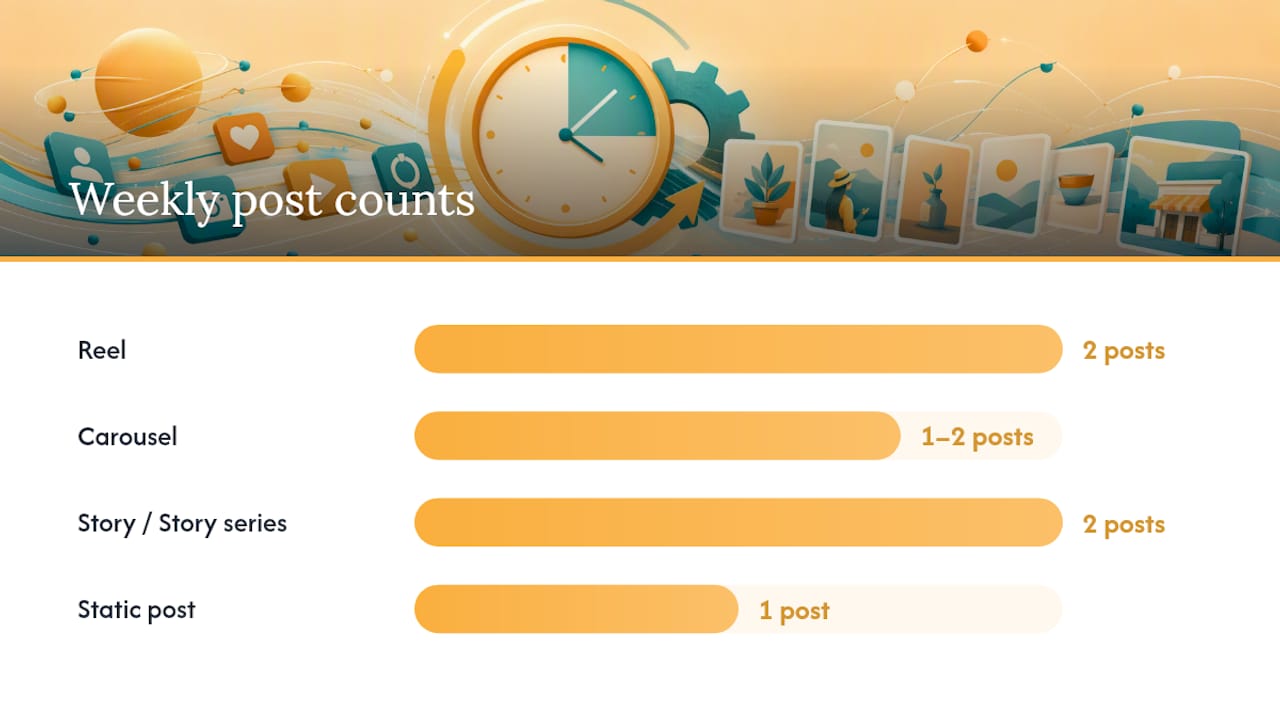
Rigid 30-day calendars break the moment a client cancels or a supply order runs late, and then the whole month feels behind. A weekly structure is easier for a small team to sustain because you’re only ever planning seven days out, and a missed Tuesday doesn’t wreck your entire month.
Here’s a sample weekly template you can copy directly into a spreadsheet or scheduler:
Day | Format | Pillar | Hook Idea | CTA | Tracking Field |
Monday | Reel | Process/behind-the-scenes | “Here’s what nobody shows you about…” | Save this | Reach, saves |
Tuesday | Story series | Relationship | Poll or Q&A sticker | Reply/DM | Story replies |
Wednesday | Carousel | Education | “3 things I wish clients knew before…” | Save for later | Save rate |
Thursday | Static post | Brand | New offer or announcement | Link in bio | Link clicks |
Friday | Reel | Client/customer proof | “Watch what happened when…” | DM to book | Shares, DMs |
Saturday | Story | Relationship | Behind-the-scenes/casual | Sticker interaction | Story completion |
Sunday | Carousel or off | Education/flex slot | Recap or FAQ | Save for later | Save rate |
If your capacity is lower, cut to three anchor posts a week (one Reel, one carousel, daily Stories) rather than skipping days randomly. If you have more capacity, add a second Reel before adding a second carousel; discovery content compounds faster than depth content. Slot promotions into the static post or announcement slot only, and keep the Reel and carousel days evergreen so your discovery content isn’t tied to a sale that ends next week.
How Do You Batch-Create a Week of Instagram Content?
Batching is what makes this system sustainable, because producing content in focused sessions rather than daily is what actually reduces burnout and increases output. Here’s the sequence:
Plan your week’s five to seven pieces against your pillars before you pick up a camera.
Script each hook in one line. Write all your hooks in one sitting.
Film everything in one location or setup at once, grouping by lighting and background.
Edit using consistent presets or templates so you’re not making creative decisions from scratch each time.
Schedule the finished batch into your calendar tool immediately, before the motivation fades.
For a 1 to 3 hour session, film three to four Reels back to back, snap the stills you need for a carousel, and record two or three Story clips you can drip out through the week. Keep editing decisions minimal, same caption font, same transition style, same intro frame, so you’re not reinventing the format every time.
Pro Tip: Reuse footage across formats. A single client testimonial can become a Reel this month and a carousel quote graphic in eight to twelve weeks, when the algorithm and your audience have both moved on from seeing it the first time.

Our guide on creating Reels that actually get views covers filming techniques that speed up this exact batching process.
How Do You Write Hooks and Captions That Instagram Rewards?
The first three seconds of a Reel decide whether it gets watched or scrolled past, and retention in that opening window is one of the strongest signals Instagram uses to decide who else sees it. Keep most Reels under 90 seconds; longer videos need a very strong reason to hold attention that long.
For carousels and feed posts, the caption’s first line functions as your hook since it’s what shows before “more” gets tapped. A reliable formula:
Headline: state the problem or curiosity gap in one line.
Value: deliver the actual insight, tip, or story.
CTA: tell them exactly what to do next.
Match your CTA to your goal rather than defaulting to “link in bio” every time:
“Save this for later” targets save rate and depth content.
“DM me to book” targets qualified leads directly.
“Tap the link in bio” targets trackable profile conversions.
Niche, specific hashtags also outperform broad generic ones now that Instagram uses them to categorize content topically rather than just as reach hacks.
What Metrics Should You Track and How Often?
Vanity metrics like follower count tell you almost nothing about whether your plan is working. Track four numbers instead: reach per post, save rate, share rate, and follower conversion rate (how many profile visitors take your CTA action).
Expect to see behavioral patterns emerge in 4 to 6 weeks, with compounding growth showing up around the 3-month mark once the algorithm has enough consistent signal to trust your content.
Run a simple decision loop every 30 days:
If save rate and share rate are climbing, double down on that pillar and format combination.
If reach is flat but saves are strong, your content quality is fine; your Reel hooks need work.
If reach is strong but saves are low, you’re getting discovered but not delivering enough value to stop the scroll.
This loop matters more than any single post’s performance, since one post says little but a month of posts against the same three metrics tells you exactly where to adjust.
What Tools Keep an Instagram Content Plan Running Smoothly?
Your content-calendar template needs seven fields to function: date, surface (Feed/Reel/Story), pillar, hook, caption, assets needed, and a UTM link if you’re tracking clicks externally. Miss the UTM field and you’ll never know which post actually drove a website visit.
Before scheduling, run through a quick checklist:
Thumbnail selected (not an auto-generated blurry frame)
Caption written with a keyword-relevant opening line
Alt text added for accessibility
Sound rights confirmed if using trending audio
For deeper format ideas when your pillar well runs dry, our list of engaging post formats and Story ideas both work as refill sources. For audience-level insight beyond Instagram’s native analytics, a partner resource like AI-driven audience analytics can sharpen who you’re actually building pillars for.
How SOL Social Media Applies This Framework for Clients
SOL Social Media runs this exact sequence for small-business clients: lock one goal, map 3 to 5 pillars, batch a week’s content in a single session, then measure against the same three core metrics every month. One healthcare client shifted from daily random posting to a five-post weekly structure built around two pillars. Saves and DM inquiries both rose within the first month, proof that structure beats volume.
The Part of This Plan Most Small Businesses Skip
The instinct when Instagram growth stalls is to post more. Post daily, chase every trend, add a fourth pillar to cover more ground. That instinct is almost always backwards. The accounts that grow steadily are the ones that narrow, not widen: one goal, a handful of pillars they repeat until the audience recognizes the pattern, and a weekly rhythm they can actually sustain past the first excited month.
The conventional advice oversells “consistency” as if it’s just about showing up daily. Consistency that matters is format consistency and message consistency, showing up with the same three or four content types tied to the same goal, week after week, so the algorithm and the audience both learn what to expect from you. A business posting seven different content types a week with no pillar structure looks active but rarely converts, because nothing repeats long enough to build recognition.
If you take one thing from this system, take the batching. Most small-business owners abandon their content plan not because the strategy was wrong but because daily content creation is exhausting. A single focused session that produces a week’s worth of posts removes the daily decision fatigue that kills most plans by week four.
— SOL Social Media
Want an Agency to Run This Plan for You?
Everything above is buildable in-house, but running it well every week for months takes time most small-business owners don’t have between actually running the business. That’s the gap SOL Social Media closes: instead of you batching, writing captions, and tracking save rates on top of your existing workload, our team handles the monthly content planning, batching, and ongoing management directly.
Depending on where you’re starting, that might mean full monthly content management, a batching session run alongside your team, or a training session that hands your staff this exact framework so they can execute it themselves. A first consult typically starts with a discovery call about your goal and current posting habits, followed by a sample content plan built around your specific pillars before anything is signed. If you’d rather have a team execute the weekly system than build it solo, our social media engagement services page outlines what ongoing management looks like and how to book a first call.
Sources
FAQ
What Is the 5-3-1 Rule for Instagram?
The 5-3-1 rule suggests posting 5 pieces of curated or repurposed content, 3 original pieces, and 1 personal or behind-the-scenes post each week. It’s a helpful ratio for variety, but pairing it with defined pillars, as covered above, keeps the mix purposeful rather than random.
How Many Followers Do You Need on Instagram to Make $1,000 a Month?
There’s no fixed follower count, since income depends on conversion rate, offer price, and niche far more than audience size. A small account with a highly engaged, high-save-rate audience can convert better than a larger, passive one.
What Is the Best Way to Plan Instagram Content?
Start with one measurable goal, build 3 to 5 content pillars around it, assign formats to each pillar, then schedule a repeatable weekly structure you can batch-create in a single session. SOL Social Media builds this exact sequence for its content planning clients.
What Is the 3-2-1 Rule on Instagram?
The 3-2-1 rule is a weekly posting guideline: 3 Reels, 2 carousels, and 1 static or Story-focused post. It’s a reasonable starting ratio, though the ideal mix should shift based on your specific goal and audience behavior rather than following the ratio rigidly.
Recommended
Comments