


Customer Service on Social Media: Your 2026 Guide

TL;DR:
Social media customer service involves delivering support through platforms like Facebook, Instagram, X, TikTok, WhatsApp, and LinkedIn, using comments, messages, and chatbots. Responding quickly and empathetically builds trust, while integrating proactive strategies and personalized replies enhances customer experiences. Effective management combines AI tools, trained staff, and clear procedures to handle issues and protect brand reputation.
What is customer service on social media?
Social media customer service is the practice of helping customers through platforms like Facebook, Instagram, X, TikTok, WhatsApp, and LinkedIn, using public comments, private messages, and AI-powered chatbots. It is not a backup channel. It is where your customers already are, and 75% of consumers prefer messaging businesses the same way they message friends and family.
The interactions span a wide range:
A customer tags your brand in an Instagram comment about a delayed order
Someone sends a Facebook Messenger DM asking about your return policy
A frustrated buyer posts publicly on X, visible to thousands of followers
An AI chatbot answers a FAQ at 11 PM so your team does not have to
Every public reply is also a marketing signal. Prospects watching how you handle a complaint decide whether to trust you before they ever contact you directly.
1. Respond fast and with genuine empathy
Speed is the single most important variable in social customer service. 40% of consumers expect a response within one hour, and 79% expect one within 24 hours. Missing those windows does not just frustrate the person asking. It signals to everyone watching that your brand is slow or indifferent.
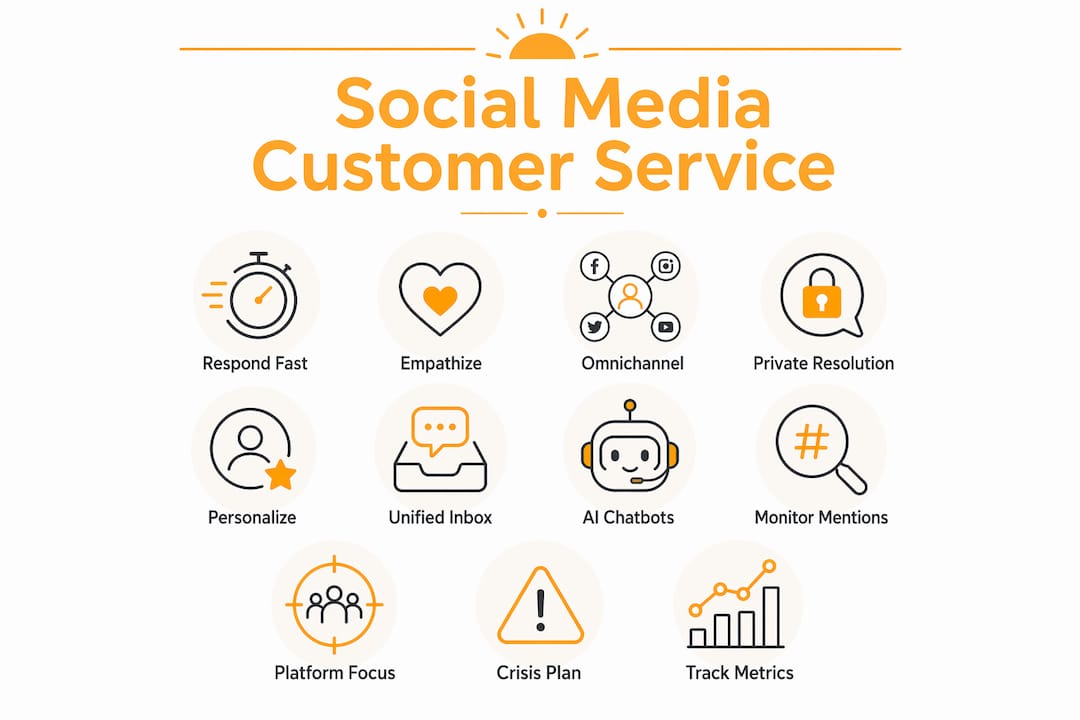
Empathy is the other half. Acknowledge the customer’s frustration before moving to resolution. “I completely understand why this is frustrating” lands differently than jumping straight to a fix.
2. Build a proactive, omnichannel support strategy
Social media is no longer a side inbox managed by whoever has a spare moment. The strongest brands treat it as a core support channel with clear ownership, routing rules, and response targets. That means your social support strategy connects directly to your broader customer experience, not just your marketing calendar. Proactive content, like answering common questions before they become complaints, reduces inbound volume and builds credibility.

3. Move public complaints to private channels smoothly
When a conversation requires personal details or nuanced back-and-forth, move it out of the comments. The key is making that transition frictionless. Saying “We sent you a DM” keeps the customer in the same platform and the same conversation thread. Telling someone to “email support@…” forces them to start over, which compounds frustration.
Acknowledge the issue publicly first so onlookers see you responded, then resolve privately. That sequence protects the customer’s privacy and your brand’s reputation at the same time.
4. Personalize every templated response
Templates are a foundation, not a finished product. Taking 30 extra seconds to add the customer’s name and reference their specific issue changes how the reply lands. A response that starts “Hi Marcus, I see your order from last Tuesday” reads completely differently than “Dear Valued Customer.”
Pro Tip: Build a library of response frameworks for your most common scenarios, then train your team to adapt them rather than copy-paste. Consistency and personalization are not opposites.
5. Use a unified inbox to manage every platform in one place
Juggling separate tabs for Instagram DMs, Facebook comments, X mentions, and TikTok replies is how messages get missed. Unified inbox tools consolidate all incoming contacts into a single queue with routing, assignment, and collision detection so two agents never respond to the same message. For Colorado small businesses managing multiple platforms without a large team, this is the operational shift that makes consistent response times achievable.
6. Deploy AI chatbots for 24/7 FAQ coverage
AI chatbots handle routine questions around the clock, freeing your human agents for complex or emotionally charged issues. Modern chatbots remember conversation history and escalate to a live agent when the situation calls for it, without the customer having to repeat themselves. The result is faster first responses during off-hours and a more manageable queue during peak periods.
7. Monitor brand mentions beyond direct tags
Most customers do not tag brands when they complain. They just post. Social listening tools catch those untagged mentions and surface sentiment trends before they become a crisis. Real-time alerts let your team respond to emerging issues within minutes rather than discovering them hours later when the conversation has already spread.
8. Customize your approach by platform
Different platforms demand different response styles. X rewards speed and brevity. Facebook Messenger suits longer, detailed exchanges. Instagram is visual and conversational, especially for product questions. LinkedIn calls for a more formal register, particularly for B2B inquiries. TikTok comment engagement also affects algorithmic reach, so fast replies there serve double duty. Matching your tone and format to the platform shows customers you understand where they are. For a deeper look at platform-specific tactics, SOL Social Media’s engagement strategies break down what works on each channel.
9. Prepare a crisis response plan before you need it
Social media crises compound fast. A post with 1,000 shares in hour one can reach 100,000 by hour three. Brands that respond within the first 60 minutes with a genuine acknowledgment consistently experience less reputational damage than those that go quiet. Pre-approved crisis templates, a clear chain of command, and a monitoring setup that alerts your team to volume spikes are not optional extras. They are the infrastructure that keeps a bad day from becoming a brand disaster.
10. Track the metrics that actually measure performance
You cannot improve what you do not measure. The KPIs that matter most for social customer service:
First response time: Are you hitting the one-hour benchmark?
Resolution rate: What share of issues get fully resolved on the channel?
CSAT (Customer Satisfaction Score): How do customers rate the interaction?
Queue volume by topic: Which issue types drive the most contacts?
Escalation rate: How often do social issues need to move to another channel?
Tracking these consistently reveals where your process breaks down and where your team excels. Pair this data with your broader customer retention strategy to see how social support directly affects loyalty.
11. Understand what social media management actually costs
Social media management pricing in the U.S. ranges from $250 to over $10,000 per month, depending on scope, platform count, and service depth. Most small businesses pay $1,000–$3,000 per month for social media management. Basic plans start around $300–$1,000 monthly, while premium plans cost $3,000 to $10,000+ each month, based on the level of service and number of platforms managed. Common add-ons and separate ad management fees can increase your total spend, so clarify deliverables with your provider.
What SOL Social Media sees working right now
The businesses that handle social customer service well in 2026 share one trait: they stopped treating it as a marketing afterthought and started treating it as a brand function. That shift changes everything, from how you staff it to how you measure it.
At SOL Social Media, we see Colorado small businesses make the most progress when they align their support voice with their content voice. When the same warmth and authenticity that drives your posts also shows up in how you respond to a complaint, customers notice. That consistency builds the kind of trust that advertising cannot buy.
The other pattern we see consistently is that businesses underestimate the value of training. Agents who know how to de-escalate publicly, when to move a conversation private, and how to write a reply that feels personal rather than processed, those skills produce measurably better outcomes than any tool alone. Pairing the right technology with genuinely trained people is what separates a social support operation that builds loyalty from one that just closes tickets.
If you are thinking about how integrated marketing and service strategy fits your structure, that alignment question is worth answering before you invest in tools or headcount.
SOL Social Media’s social engagement services are built for small businesses that want real results without the overhead of an enterprise setup. Whether you need full management, a strategy audit, or team training, we build the plan around your goals and your voice.
Key Takeaways
Effective social media customer service requires speed, personalization, the right tools, and a trained team working from a clear strategy.
Point | Details |
Response time benchmark | 40% of consumers expect a reply within one hour; 79% within 24 hours. |
Public-to-private transition | Acknowledge publicly, then move to DM. Never send customers to email to restart. |
AI and human balance | Chatbots handle FAQs 24/7; human agents take complex and emotional issues. |
Pricing range | Most small businesses pay $1,000–$3,000/mo; the full range runs from $250 to over $10,000 per month. |
Crisis response window | Responding within the first 60 minutes consistently reduces reputational damage. |
FAQ
What is an example of social media customer service?
A customer posts on Instagram about a missing order, and the brand replies publicly to acknowledge the issue, then sends a DM to resolve it privately. That sequence shows responsiveness to all observers while protecting the customer’s account details.
What is social media customer service?
Social media customer service is support delivered through platforms like Facebook, Instagram, X, TikTok, WhatsApp, and LinkedIn via public comments, private messages, and AI chatbots. It functions as a live, public-facing service channel, not just a marketing tool.
How quickly should brands respond on social media?
40% of consumers expect a response within one hour, and 79% expect one within 24 hours. Leading brands use a mix of AI chatbots for instant replies and trained agents for complex issues.
How much does it cost to pay someone to manage your social media?
Most U.S. small businesses pay $1,000–$3,000 per month for social media management, with basic plans starting around $300–$1,000 per month and premium service packages ranging from $3,000 to over $10,000 monthly, depending on scope and platform count.
How do AI chatbots improve social customer service?
AI chatbots provide instant answers to common questions around the clock, reducing the volume human agents handle and keeping response times consistent during peak periods. Modern chatbots escalate to a live agent when the issue requires judgment or empathy.
Recommended
Comments